
Hervey Bay summers don’t just feel hot — they feel heavy. That “sticky” discomfort is why air conditioning installation here needs a different mindset to the typical sales pitch of “bigger unit = colder house”. In a coastal, humid climate, a good install is the one that manages moisture as well as temperature, runs efficiently without constant cycling, and is set up to survive the realities of salt air and summer storms.
If you’re planning an air conditioning installation in Hervey Bay (whether it’s a split system for a living area, a multi-room plan, or a ducted upgrade), the most valuable thing you can do is understand what good looks like before anyone turns up with brackets and pipework.
Hervey Bay comfort isn’t just temperature — it’s moisture
The Bureau of Meteorology’s long-term data for Hervey Bay Airport makes the point clearly: mean maximum temperatures sit around 30°C in January and February. But the bigger story is what the air is doing. Mean 9am relative humidity is commonly in the high 60s to high 70s across much of the year (for example, 67% in January, 70% in February, 73% in April, 78% in June).
Even more telling is dew point — a practical measure of “how much moisture is in the air”. Hervey Bay’s mean 9am dew point sits around 20.2°C in January and 20.7°C in February. When dew point is high, people feel uncomfortable even at temperatures that would feel fine in a dry climate. That’s why locals sometimes say, “It’s not that hot, it’s just… gross.”
A good installation plan aims for stable comfort — which usually means longer, steadier run time (better moisture removal) rather than short blasts of cold air that leave the space clammy.
What a “humidity-smart” installation actually changes
Most homeowners assume dehumidification is purely a feature of the unit. In reality, installation choices heavily influence whether the system can remove moisture properly and consistently.
Sizing for run time, not just room size
In a humid climate, oversizing can backfire. A system that cools a room too quickly may shut off before it has time to pull enough moisture out of the air. The result is a room that reads “cold” but still feels sticky — and sometimes even develops odours over time if moisture management is poor.
The right capacity is about the whole picture: room volume, sun load, insulation, glazing, how often doors are opened, and how the space is actually used (daytime living zones vs night-time bedrooms). The best outcome is usually a unit that can hold temperature steadily instead of constantly starting and stopping.
Airflow design that prevents “cold spots” and “dead zones”
In Hervey Bay homes, layout matters as much as size. A single open-plan area can behave very differently to a segmented Queenslander with hallways, higher ceilings, and rooms that don’t share airflow.
A quality installer will treat airflow like a design problem: where the air will travel, where it will stall, and where people actually sit or sleep. That’s what prevents the classic complaint: “The lounge is freezing but the back bedrooms never feel right.”
Condensate drainage that’s planned, not improvised
Moisture removed from the air becomes water — and in humid conditions, there can be a lot of it. Drainage needs to be routed with the same care as pipework: with proper fall, safe termination, and protection against staining, leaks, and hidden damp. If drainage is treated as an afterthought, it’s one of the fastest ways a “new install” turns into a recurring headache.
Coastal placement that considers corrosion, noise and service access
Hervey Bay isn’t uniform: bayside exposure, prevailing breezes, and salt air can accelerate wear on outdoor units if they’re placed poorly. Outdoor placement should protect airflow (no tight alcoves), reduce noise impact on bedrooms and neighbours, and keep servicing practical — because even a great system becomes a problem if it’s installed somewhere no technician can reach without a ladder circus.
The electrical side: the hidden factor that can make or break an install
Air conditioning installation isn’t just a refrigeration job; it’s also an electrical job. And in Queensland, there are clear compliance expectations around electrical work documentation.
For electrical installation work, a certificate of testing and compliance must be completed and provided. WorkSafe Queensland also sets out the information that must be included on that certificate.
Why does this matter for homeowners?
Because electrical shortcuts often don’t show up on day one. They show up later as nuisance tripping, undervoltage issues, unexplained faults, or “mystery problems” that become expensive to diagnose. A good installer doesn’t treat the switchboard and circuit requirements as an add-on — they treat them as part of the core design.
If you’re planning a larger system (multiple splits or ducted), switchboard capacity and circuit planning should be discussed early, not discovered on installation day.
Refrigerant licensing: the simplest credibility check you can do
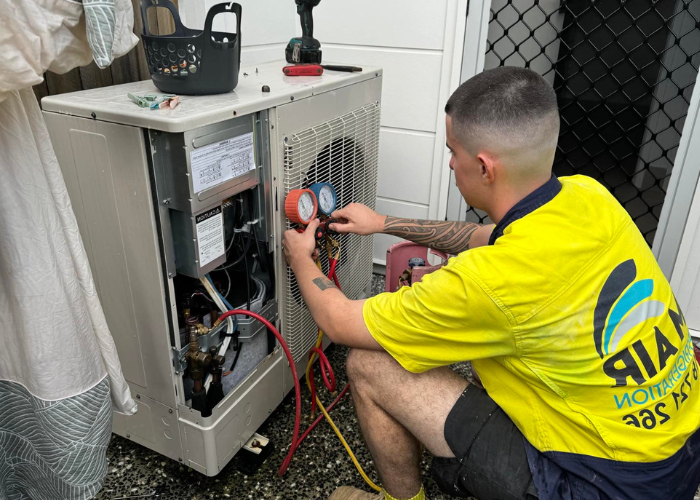
Any person who carries out work in relation to refrigeration and air conditioning equipment that carries the risk of refrigerant being emitted — including installing and commissioning — must hold a Refrigerant Handling Licence. ARC also notes that installing split system air conditioners requires a refrigerant handling licence (even though a refrigerant trading authorisation isn’t required for equipment where refrigerant is contained).
This isn’t paperwork trivia. Correct evacuation, leak testing and charging protect performance, efficiency and compressor life. If those steps are rushed or skipped, you can end up with a system that “works” but never runs the way it should.
What you should expect during installation (the quality checkpoints)
A professional installation has a rhythm. Not because it’s slow — because it’s controlled.
You should expect:
- A clear confirmation of placement (indoors and outdoors) before anything is mounted.
- Clean routing decisions (pipework and cabling planned to suit the home, not just what’s easiest in the moment).
- Proper commissioning steps that confirm performance rather than “it turns on, job done”.
- A tidy finish — including neat trunking/covering where required, weather sealing, and a site left clean.
The best installers also do something underrated: they explain why your system has been set up the way it has. That conversation is often where you learn whether the design was thoughtful or generic.
The consumer angle: your install is a service, and it comes with protections
Under Australian Consumer Law, services come with consumer guarantees — including that they’ll be provided with due care and skill. This matters because air conditioning installation is a high-impact service: if it’s not done properly, the cost of “making it right” later can dwarf the difference between quotes.
In practice, this means you should feel comfortable asking:
- What documentation will I receive for the electrical work?
- Who is performing the refrigerant work, and are they appropriately licensed?
- What commissioning steps are included?
- What happens if performance isn’t right in the first weeks?
A confident installer won’t dodge those questions — they’ll welcome them.
Why local experience matters in Hervey Bay
The two things that punish generic installations here are humidity and coastal exposure. A team that installs air conditioning in Hervey Bay week in, week out tends to design differently — because they’ve seen what fails, what rusts, what drains poorly, what ends up noisy, and what actually keeps families sleeping comfortably in February.
JM Air and Refrigeration Hervey Bay is based in Dundowran and works across the local area. (jmairherveybay.com.au) That local context is valuable — not as a marketing line, but because the install choices that work in a dry inland town don’t always hold up on the coast.
The takeaway: chase “stable comfort”, not just cold air
If you want the best result from air conditioning installation in Hervey Bay, judge the job by whether it’s designed to deliver stable comfort: consistent temperature, controlled humidity, sensible noise levels, clean drainage, compliant electrical work, and commissioning that locks performance in from day one.
In this climate, the best installs aren’t the ones that feel icy for ten minutes. They’re the ones that make the house feel calm — even when the air outside is heavy.